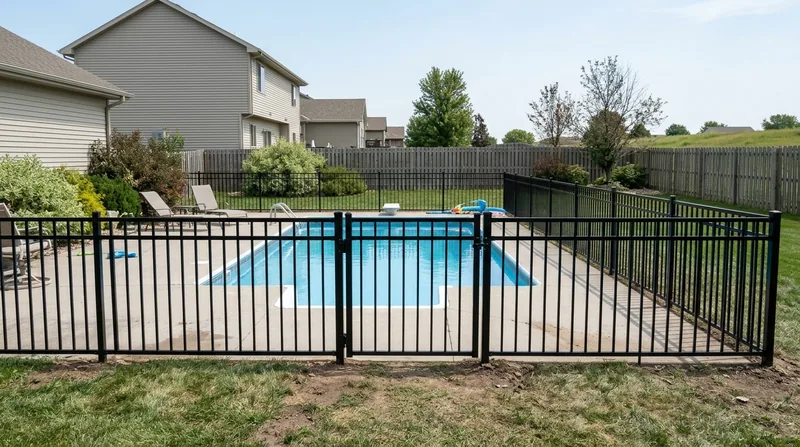




Lincoln's newer residential neighborhoods, from Fallbrook to the Highlands and Wilderness Hills, are home to an increasing number of backyard pools, and with them comes a critical safety requirement: a pool fence installation that meets Nebraska's pool barrier code. On the gently rolling terrain of the capital city, where freeze-thaw cycles heave posts and spring storms test every fastener, a pool barrier must do more than meet code on day one. It must hold its latch after winter, keep its gate closing and latching reliably year after year, and stand firm against the wind and snow that sweep across the Great Plains. Lincoln Fence installs aluminum, mesh, and glass pool barriers built to the code that applies at your address, with self-closing, self-latching gates and posts set below the frost line so the barrier works as intended through every season.
Why Pool Barrier Code Matters in Lincoln
A pool barrier is not a luxury upgrade or a neighborhood preference. Nebraska law and local codes require a four-sided enclosure around any residential pool, with specific height, spacing, and gate hardware requirements. The barrier must prevent a child from reaching the water unattended. In Lincoln's subdivisions, where properties sit close together and families share the same building stock and climate, a compliant barrier protects your family and your liability, and it is the only approved method to meet the legal standard. The code is not optional, and it is not something a homeowner can guess at.
- Pool barriers must be at least 4 feet tall measured from the ground on the pool side of the fence.
- Openings and gaps between vertical elements must not allow a 4-inch sphere to pass through.
- Gates must be self-closing and self-latching, with the latch positioned at least 54 inches above the ground.
- Posts must be set in concrete below the frost line to prevent movement after winter freeze-thaw cycles.
- The barrier must completely surround the pool with no gaps at corners or transitions.
Compliance with these rules is your responsibility as a pool owner, and final determination rests with the authority having jurisdiction in your city or county. We install pool fencing to meet local pool barrier codes, and we walk the requirements with you before a single post is set.
Key info: Lincoln's pool barrier code is enforced at the city level. Before any work begins, check with the Lincoln Building and Safety Department to confirm the exact height, spacing, and gate hardware requirements that apply to your property. Deed restrictions or HOA architectural standards in master-planned communities like Wilderness Hills or the Highlands may impose stricter rules on material or color, and those must be verified with your homeowners association.
For the full text of Nebraska's pool barrier statute and local amendments, see the City of Lincoln Planning and Zoning Department website.
How We Install Pool Barriers in Lincoln: A Step-by-Step Process
A pool barrier is only as good as its installation. Posts must be set deep enough to stay below the frost line even after the ground heaves in winter, and gates must be hung and latched so they still work reliably after years of freeze-thaw and wind. We begin with a site walk, measure the pool perimeter, and confirm the exact code requirements with you and with the building department if needed. Then we set posts in concrete, install the barrier panels or mesh, and hang self-closing, self-latching gates with hardware rated for pool use. Every step is done on site by the same crew, not farmed out.
- We measure the pool perimeter and identify the best locations for posts based on grade, frost depth, and code spacing rules.
- We call 811 to locate underground utilities before we dig any post holes.
- We set posts in concrete at a depth below the local frost line, typically 3 to 4 feet in Lincoln, to prevent heaving.
- We install barrier panels, mesh, or glass to the specified height with proper spacing between vertical elements.
- We hang self-closing, self-latching gates with hardware positioned to meet code and function after winter.
- We test every gate to confirm it closes and latches reliably before we leave the site.
This methodical approach means your barrier will pass inspection and keep working through Lincoln's hard winters and windy springs.
Example: A pool in south Lincoln's Fallbrook subdivision sits on a lot with clay soil and a frost line at 42 inches. We set posts 48 inches deep in concrete, hang a 4-foot-6-inch aluminum barrier with 3-inch vertical spacing, and install a self-latching gate on hinges rated for pool use. After the first winter, the barrier sits exactly where it was set, and the gate still closes and latches perfectly.
For more on how proper installation prevents common fence failures, see our Fence Post Repair and Replacement page.
Pool Barrier Materials: Aluminum, Mesh, and Glass
| Material | Description | Best for |
|---|---|---|
| Aluminum Fence | Powder-coated aluminum pickets or slats, typically black or bronze, set vertically on aluminum rails with aluminum posts. | Homeowners who want a durable, low-maintenance barrier that does not rust and blends with modern pool decks. Aluminum resists wind and does not require staining or sealing. |
| Mesh Pool Fence | Removable or permanent high-tensile mesh panels stretched between aluminum or steel posts, typically 4 feet tall with self-closing hinges on removable gates. | Homeowners who want an unobstructed view of the pool or who plan to remove the barrier seasonally. Mesh is lightweight, affordable, and does not block sightlines. |
| Tempered Glass Panels | Clear or frosted tempered glass panels set in aluminum frames, typically 4 to 6 feet tall, with glass gates and self-latching hardware. | Homeowners who want a transparent barrier that maximizes sightlines and aesthetics. Glass requires professional installation and is the highest-cost option but offers the clearest view. |
| Self-Closing Pool Gate Hardware | Hinges and latches rated for pool use, with springs or pneumatic closers that pull the gate shut automatically and a latch positioned 54 inches or higher. | All pool barriers. Self-closing hardware is not optional; it is a code requirement and must be tested and adjusted after installation and after each winter. |
Each material has a role depending on your budget, your sightline preference, and your maintenance tolerance. We recommend aluminum or glass for permanent barriers in Lincoln because they resist weathering and do not require the seasonal maintenance that wood or vinyl demands in our freeze-thaw climate. Mesh works well for temporary or removable barriers during pool season. We can show you samples and walk you through the tradeoffs on a site visit.
Pool Fence Installation Cost in Lincoln: What to Expect
The cost of pool fence installation in Lincoln depends on the perimeter of your pool, the material you choose, the condition of your ground, and whether the barrier must clear existing trees or structures. A simple aluminum barrier around a small pool in a flat yard will cost less than a glass barrier around a large pool on sloped terrain or with mature trees nearby. Most pool barriers in Lincoln start at $34 per linear foot for aluminum mesh or basic aluminum picket, and rise from there based on material grade, height, and site complexity.
For example, a 30-foot-by-40-foot pool with a 140-foot perimeter in a Fallbrook subdivision might run $4,500 to $6,500 for an aluminum barrier with two self-latching gates, posts set in concrete, and all labor. A glass barrier around the same pool could run $8,000 to $12,000. A removable mesh barrier, installed seasonally, might be $2,500 to $3,500 per installation. Sloped terrain, mature trees, rocky soil, or proximity to structures will push costs up because posts must be set with extra care and the barrier may need to be racked or stepped to follow grade.
We recommend getting 2 or 3 estimates from local contractors before you commit. Each estimate should include the total linear footage, the material and height, the number of gates, the depth posts will be set, and a breakdown of labor and materials. Do not choose based on price alone; choose based on whether the contractor can explain the code, confirm the frost line depth, and commit to testing the gates before you sign off.
For a detailed pricing overview and to request a free, no-obligation estimate, see our Pricing page or call us at (402) 858-4049.
Pool Fence Installation Near Me: What to Look for When Hiring a Contractor in Lincoln
Hiring a local contractor for pool barrier installation in Lincoln or nearby areas like Waverly, Hickman, or Seward means you get someone who knows the frost line, the soil, the code, and the weather. When you call, ask whether the contractor has installed pool barriers in your neighborhood or on similar soil, whether they set posts below the frost line as standard practice, and whether they test gates before they leave the site. Ask for references from pool barrier jobs completed in the last two years, and call those homeowners to ask whether the barrier still closes and latches reliably and whether the contractor was responsive if any adjustments were needed after installation.
- Confirm that the contractor carries general liability and workers' compensation insurance, and ask to see a certificate of insurance before any work begins.
- Verify that the contractor is familiar with the pool barrier code that applies at your address, and ask them to walk you through the specific height, spacing, and gate hardware rules.
- Check that the contractor calls 811 to locate utilities before digging and obtains any permits required by your city or county.
- Confirm that the contractor understands your HOA or deed restrictions if you live in a master-planned community, and will submit materials for approval if required.
- Ask whether the contractor will test every gate and make adjustments before leaving the site, and whether they offer any follow-up service if gates need re-latching after winter.
Fence licensing in Nebraska is set at the state and local level. State contractor registration is handled by the Nebraska Department of Labor for projects that meet certain thresholds, and cities and counties may impose their own licensing or permitting requirements. It is your responsibility to confirm what applies to your project and address.
Ready to move forward? Contact us at (402) 858-4049 for a free estimate, or visit our Aluminum and Ornamental Iron Fencing page to see more of our work.
Pool Fence Installation in Lincoln: Pricing Guide
| Service | Price | Details |
|---|---|---|
| Aluminum Picket Pool Barrier | Starting at $34/ft | Powder-coated aluminum pickets, 4 feet tall, posts set in concrete, includes one self-latching gate |
| Removable Mesh Pool Fence | Starting at $22/ft | High-tensile mesh panels between aluminum posts, 4 feet tall, removable gates, seasonal installation and removal |
| Tempered Glass Pool Barrier | Starting at $65/ft | Clear tempered glass panels in aluminum frames, 4 to 6 feet tall, maximum visibility, includes glass gate with self-latching hardware |
| Complex or Large-Scale Installation | On estimate | Sloped terrain, mature trees, rocky soil, proximity to structures, or multiple gates require site assessment before pricing |
| Travel and Site Visit | Included | No separate call-out fee or mileage charge in Lincoln and surrounding service areas within 25 miles |
| Free Estimate | No obligation | Response within 24 hours, site walk, measurement, code review, and written estimate with no pressure to book |
Indicative pricing, the exact cost depends on square footage, finish, and site access. Free personalized estimate within 24h at (402) 858-4049.


