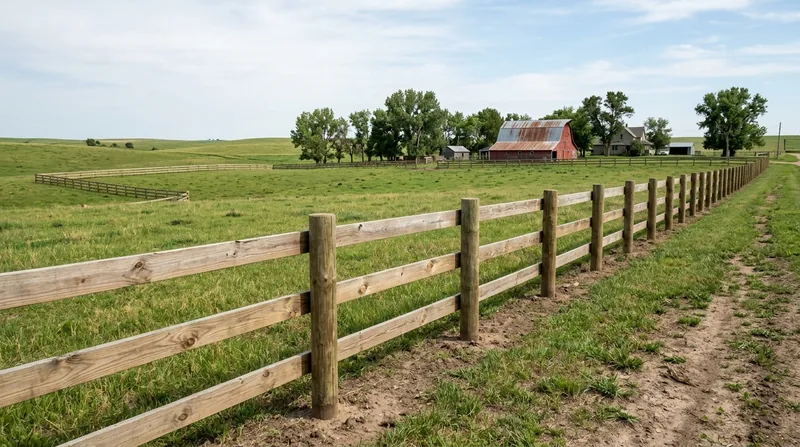




Farm fence installation in Lincoln spans the gently rolling prairie and clay-heavy acreage that ring the capital, from the edge of Havelock east toward Waverly and south toward Crete. Ranches, hobby farms, and horse properties on the outskirts of town need fencing that holds against deep winter frost, spring thaw heave, and the open-sky winds that sweep across Lancaster and Saunders counties. Split rail, no-climb horse fence, field wire, and pipe fencing built on posts set deep in concrete keep livestock contained and pasture lines clear across terrain that rolls gently but demands braced corners and straight runs measured in hundreds of linear feet. We work from your property line and build ranch fencing that lasts through freeze-thaw cycles, heavy snow loads, and the prairie weather that tests every post at the ground line.
Why Ranch Fencing Matters on Lincoln Acreage
Acreage around Lincoln sits on heavy loess and clay soil that heaves in winter and stays wet in spring. Posts set shallow rot at the ground line within five to seven years; posts set in concrete to frost depth, 42 to 48 inches in this region, stay firm through decades of freeze-thaw. Open land catches wind that pushes unsupported panels sideways and strains corner posts. Horses and cattle need no-climb horse fence or field wire that they cannot push through or catch a hoof in, and gates must swing clear for trailers and equipment. A fence that fails on acreage is not just unsightly; it lets stock wander into neighbors' pastures, onto roads, and into liability claims.
- Posts set in concrete to frost depth resist heave and stay plumb through spring thaw cycles.
- Braced corners with anti-sag bracing hold against wind pressure and livestock weight.
- Split rail and no-climb horse fence keep horses and cattle secure without injury risk.
- Field wire and pipe fencing span long runs with minimal posts and maximum visibility.
- Gates sized for trailers and equipment reduce wear and damage to the main fence line.
Proper ranch fence installation around Lincoln means fewer repairs, longer intervals between maintenance, and the peace of mind that your stock stays where you put them.
Key info: Lincoln sits at the edge of the Great Plains, where winter frost reaches 42 to 48 inches. Posts set shallower than that frost line heave up as soil freezes and thaws, breaking the bond and leaving them loose. Acreage fencing here must be set deep, in concrete, and braced at corners to handle the annual stress cycle.
For more on how frost and soil conditions affect any fence repair, see our fence post repair page.
How We Build Ranch Fencing Across Lincoln and Surrounding Counties
We start with an on-site walk of your property line, using your existing survey as reference. We locate utilities with an 811 call before digging any post holes, mark the line with string and stakes, and plan post spacing, corner bracing, and gate locations to match your terrain and stock type. We set posts in concrete to frost depth, spaced to code for the fence type you choose, and build straight runs using a level and string line over rolling ground. Corners get anti-sag bracing or V-bracing to handle wind and livestock pressure. Gates are hung on heavy hinges with self-closing, self-latching hardware where you need it, and sized to clear trailers and equipment. We work in spring and fall when the ground is workable and frost is not an active risk.
- We call 811 to locate utilities before any digging begins, as required by Nebraska law.
- Posts are set in concrete to 42 to 48 inches, the frost line depth for this region.
- We string and level each run to keep rails and wire straight across rolling terrain.
- Corners are braced with anti-sag or V-bracing to resist wind and animal pressure.
- Gates are hung on heavy hinges with self-closing hardware and sized for your equipment.
A well-built ranch fence holds its line for decades and keeps maintenance costs low.
Example: A 10-acre horse property near Waverly with rolling terrain and clay soil needs 800 linear feet of no-climb horse fence, four corner posts with V-bracing, two 10-foot gates, and posts set in concrete. We string the line, dig to frost depth, set posts, hang the gates, and the owner can turn horses out within a week. No heave, no sagging, no surprises in spring thaw.
See our gate installation page for details on gate sizing and hardware options.
Ranch Fencing Methods and Materials
| Approach | Description | Best for |
|---|---|---|
| Split Rail | Pressure-treated pine rails mortised into posts, spaced 4 to 6 inches apart, no wire. | Decorative ranch appearance, horses, small livestock, boundary definition. |
| No-Climb Horse Fence | Galvanized or powder-coated wire mesh welded to posts, 2-inch or 2.5-inch grid, 4 to 5 feet tall. | Horses, ponies, goats; no hoof entrapment, easy visibility, long service life. |
| Field Wire and Posts | Galvanized field wire (4-point or 5-point barbed, or smooth) stretched between posts, with or without top rail. | Cattle, large pastures, long runs, economy, quick installation over rolling terrain. |
| Pipe Fencing | Steel or galvanized pipe rails bolted or welded to posts, 2-inch or 2.5-inch diameter, high strength. | Heavy livestock, high-impact areas, gates, corrals, maximum durability and racking resistance. |
Each method is set to frost depth with posts spaced 6 to 8 feet apart (closer at corners and gates) and braced at corners to handle wind and animal pressure. Your choice depends on livestock type, budget, and how long you want the fence to hold without repair.
Farm and Ranch Fencing Cost in Lincoln: What to Expect
Ranch fencing in the Lincoln area starts at $12 per linear foot for basic split rail or field wire fencing on level ground with easy access. No-climb horse fence runs $14 to $18 per linear foot depending on wire gauge and height. Pipe fencing and corrals run $16 to $22 per linear foot. These figures include posts set in concrete to frost depth, bracing at corners, and materials delivered to your site. Travel is included within Lincoln and surrounding areas; we do not charge mileage or call-out fees.
The main factors that move cost up are terrain (rolling ground needs more labor to keep lines level), soil type (clay and rock cost more to dig), gate count and size, distance from town, and whether you need barbed wire, smooth wire, or mesh. A 500-foot run on flat ground with two gates costs less per foot than a 2,000-foot run over rolling terrain with four gates and three corner braces. We recommend getting two or three estimates so you can compare approach, materials, and timeline.
For a detailed breakdown of what we charge for different fence types and materials, see our full pricing page.
What to Look for When Hiring a Fence Contractor Near Me in Lincoln
Hiring a ranch fencing contractor is a long-term decision. The fence you build today will outlast you if it is built right, or cost you twice over in repairs if it is not. Start by asking whether the contractor calls 811 before digging, sets posts to your local frost line depth, and braces corners for wind and animal pressure. Ask for references from acreage and ranch properties they have fenced in the past three years, and call at least two. Ask whether they pull permits where required by your county or township, and whether they are familiar with any HOA or deed restrictions that apply to your property.
Fence licensing in Nebraska is handled at the state level through contractor registration, and permits and any local licensing are set by your county or city building department. You should confirm what applies to your address before signing a contract. Get a written estimate that specifies the fence type, post spacing, bracing, gate count and size, materials, and timeline. Do not sign a contract until you have at least two estimates in hand and you understand the differences between them.
For a free, no-obligation estimate on your ranch fencing project, contact us at (402) 858-4049. We respond within 24 hours and can visit your property to walk the line and answer questions.
Farm & Ranch Fencing in Lincoln: Pricing Guide
| Service | Price | Details |
|---|---|---|
| Split Rail Fencing | Starting at $12/ft | Pressure-treated pine rails set in concrete posts; cost rises with terrain difficulty and gate count |
| No-Climb Horse Fence | Starting at $14/ft | Welded mesh wire on posts to frost depth; price varies by wire gauge and height chosen |
| Field Wire and Barbed Wire Fencing | Starting at $12/ft | Galvanized wire on posts set to frost depth; terrain slope and ground type affect labor cost |
| Pipe and Corral Fencing | Starting at $16/ft | Steel or galvanized pipe rails bolted to posts; higher cost reflects material strength and durability |
| Large or Complex Projects | On estimate | Multi-gate installations, rolling terrain, rock, or special bracing need on-site assessment before pricing |
| Free Estimate | No charge | Call (402) 858-4049, response within 24 hours, no obligation to book; walk your property line together |
Indicative pricing, the exact cost depends on square footage, finish, and site access. Free personalized estimate within 24h at (402) 858-4049.


